

Many people searching for personal support face the same dilemma: should I see a therapist or work with a coach? The confusion is understandable. Both involve one-to-one conversations, both can shift how you think and feel, and both promise meaningful change. But why professional coaching differs from therapy is not a matter of style or branding. The distinctions are structural, ethical, and deeply practical. Choosing the wrong type of support does not just slow your progress. It can leave genuine needs unmet at precisely the moment you need the right kind of help.
Table of Contents
- Key takeaways
- Why professional coaching differs from therapy: the foundations
- Training, regulation, and professional standards
- What happens in sessions: goals versus healing
- The grey areas: where coaching and therapy overlap
- Choosing the right support for you
- My take on the coaching and therapy boundary
- Ready to find the right support?
- FAQ
Key takeaways
| Point | Details |
|---|---|
| Coaching is forward-focused | Professional coaching targets goals, growth, and performance for people who are already functioning well. |
| Therapy is a licensed profession | Therapists hold advanced degrees and thousands of supervised clinical hours; coaching remains largely unregulated. |
| Scope of practice differs fundamentally | Coaches do not diagnose or treat mental health conditions; therapists are trained and licensed to do so. |
| Grey areas require ethical clarity | Coaching can have therapeutic effects, but coaches must refer clients to therapists when clinical needs emerge. |
| Both can work together | Working with a coach and a therapist simultaneously is possible and can produce strong results when needs are distinct. |
Why professional coaching differs from therapy: the foundations
To understand the difference between coaching and therapy, you need to start with what each profession is actually designed to do.
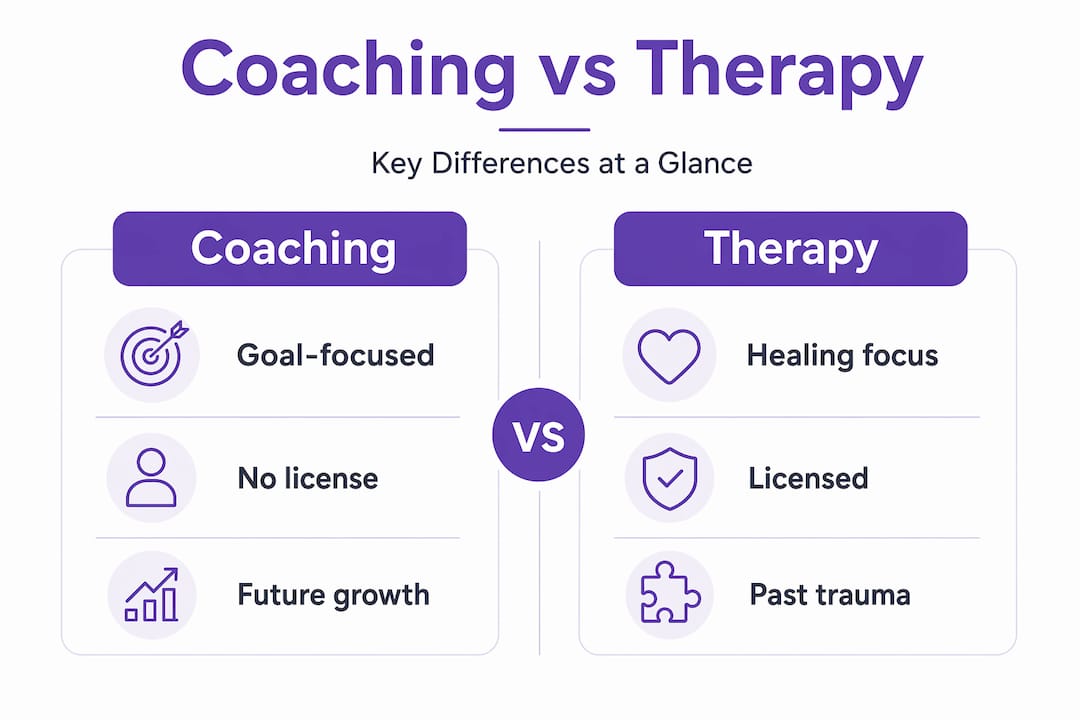
Therapy is a licensed healthcare profession. Its purpose is to diagnose and treat mental health conditions, including depression, anxiety, post-traumatic stress disorder, and personality disorders. Therapists work with the full weight of a clinical framework behind them. They explore how past experiences shape present behaviour, help clients process trauma, and support recovery from psychological distress. The relationship is clinical, even when it feels warm.
Professional coaching, by contrast, is a goal-oriented partnership. It is designed for people who are generally functioning well but want to grow, change, or perform at a higher level. A coach helps you clarify what you want, identify what is holding you back, and build a plan to move forward. The focus is on the present and the future, not on diagnosing or healing.
Here is where coaching also differs from mentoring, a distinction worth making clearly:
- A mentor shares their own experience and expertise to guide you along a similar path.
- A coach does not need to have walked your exact path. Their skill lies in asking the right questions, not providing the right answers.
- Therapy addresses psychological symptoms and clinical conditions.
- Coaching supports growth, performance, and decision-making in mentally healthy individuals.
These are not interchangeable services. They serve different purposes, and confusing them can have real consequences for the people seeking help.
Training, regulation, and professional standards
This is where the coaching vs therapy comparison becomes most concrete, and where the stakes are highest.
| Dimension | Therapy | Professional coaching |
|---|---|---|
| Education required | Master's or doctoral degree | No state-mandated degree |
| Supervised hours | 2,000 to 4,000 hours | None required by law |
| Licensing | State or national licence required | No licence required |
| Regulation | Strictly regulated healthcare profession | Largely self-regulated |
| Voluntary certification | N/A | ICF and similar bodies |
| Insurance coverage | Often covered by health insurance | Rarely covered |
The implications of this table are significant. A therapist who practises without a licence is breaking the law. A coach who practises without a certification is not. That does not make coaching less valuable. It does mean that the quality of coaching varies enormously, and that the responsibility for vetting a coach falls largely on the client.
ICF ethics training places a clear duty on coaches to refer clients to therapists when issues exceed coaching scope. This is not a soft suggestion. It is a professional obligation embedded in coaching standards. A coach who ignores this boundary is not just doing poor work. They are potentially causing harm.
Pro Tip: When evaluating a coach, ask directly whether they hold an ICF credential or equivalent, and ask how they handle situations that fall outside coaching scope. A confident, clear answer tells you a great deal about their professionalism.
What happens in sessions: goals versus healing
The practical difference between coaching and therapy becomes most visible in what actually happens during a session.

Therapy sessions often explore the roots of present difficulties. A therapist might work with you on why certain relationships trigger intense anxiety, tracing patterns back to childhood experiences. The process can be slow, non-linear, and emotionally demanding. That is not a flaw. For someone dealing with trauma, clinical depression, or persistent emotional distress, that depth is exactly what is needed. Therapy treats conditions like depression, anxiety, and PTSD that coaching is not equipped to address.
Coaching sessions look quite different. A typical coaching conversation might begin with a clear goal: you want to change careers, improve how you communicate under pressure, or make a significant life decision. From there, the coach helps you examine what is blocking progress, test your assumptions, and commit to specific steps. Accountability is built into the structure.
"The traditional view that therapy looks back and coaching looks forward is useful, but limited. Human experience is a continuum, and good coaches must navigate emotional material skillfully without stepping into therapy."
This matters for you as someone choosing between the two. Ask yourself honestly: are you dealing with symptoms that affect your daily functioning, your sleep, your ability to work or maintain relationships? That is a signal to seek professional therapy. Or are you someone who is coping well but feels stuck, unclear, or ready to make a significant change? Coaching is likely the better fit.
Coaching shines particularly in situations like:
- Career transitions and decisions about direction or purpose
- Leadership development and communication skills
- Building confidence and managing self-doubt
- Improving relationships and interpersonal dynamics
- Establishing new habits and sustaining motivation
The grey areas: where coaching and therapy overlap
The boundary between coaching and therapy is not always a clean line. Coaching can have therapeutic effects without being therapy. A coaching conversation about a difficult workplace relationship might surface grief, old wounds, or anxiety that the client had not anticipated. This is normal. It does not mean the coach has crossed a line. It means they need to handle that moment with skill and care.
Here is how ethical coaches and therapists navigate this complexity:
- Coaches acknowledge emotional depth without diagnosing. A skilled coach can hold space for a client's distress without labelling it as a clinical condition or attempting to treat it.
- Referral is a professional strength, not a failure. When a coach recognises that a client's needs exceed coaching scope, referring them to a therapist is the right and ethical response. Referral ethics are a core part of ICF standards.
- Dual credential professionals maintain strict separation. Some practitioners hold both therapy and coaching qualifications. Dual credentialled professionals must never provide coaching and therapy to the same client simultaneously. These roles operate under different legal protections and ethical frameworks.
- Working with both simultaneously is possible. A client can see a therapist for clinical mental health support and work with a coach on career goals or communication skills at the same time. The two modalities address different needs and do not conflict when boundaries are clear.
- Confusion between the two carries real risk. Unclear boundaries between coaching and therapy can leave clients receiving inadequate support, which is why understanding the distinction matters for your safety, not just your progress.
Pro Tip: If you are working with a coach and find yourself regularly exploring deep emotional pain or past trauma, raise this directly. A good coach will welcome the conversation and help you assess whether additional therapeutic support would serve you better.
Choosing the right support for you
Making this decision well requires honest self-assessment. The good news is that the criteria are fairly clear once you know what to look for.
Coaching is best suited to people who are functional, motivated, and oriented towards growth. Therapy is the appropriate choice when psychological distress, clinical symptoms, or trauma are affecting daily life. Here is a practical way to think about it:
Choose coaching if you:
- Are functioning well in daily life but feel stuck or unclear about direction
- Want to improve performance, communication, or decision-making
- Are facing a career change, life transition, or leadership challenge
- Feel motivated to take action but need structure and accountability
- Want to explore executive or life coaching options for professional growth
Seek therapy if you:
- Are experiencing persistent sadness, anxiety, or mood disturbances
- Have a history of trauma that continues to affect your relationships or behaviour
- Find that emotional distress is interfering with work, sleep, or daily functioning
- Have been diagnosed with or suspect a mental health condition
- Need a safe, clinically supported space to process significant psychological pain
If you are genuinely unsure, a consultation with a qualified professional in either field will help you assess your needs. Many therapists and coaches offer initial conversations precisely for this purpose. You can also read more about psychotherapy in the UK to understand what clinical support actually involves before making a decision.
Therapy sessions typically cost £80 to £200 and are sometimes covered by health insurance or NHS provision. Coaching sessions range from £60 to £250 or more, and are rarely covered by insurance. Cost is a real factor, and knowing this upfront helps you plan.
My take on the coaching and therapy boundary
I have seen what happens when this boundary is blurred, and it is not pretty. Coaches who drift into therapy territory without the training to back it up do not just risk their professional standing. They risk the wellbeing of the person sitting across from them.
In my experience, the most common mistake coaches make is not malicious. It comes from genuine care. A client shares something painful, the coach wants to help, and the conversation slides into territory that requires clinical skill the coach simply does not have. Good intentions do not substitute for clinical training.
What I have learned is that holding the boundary clearly is not a limitation. It is what makes coaching powerful. When a coach stays in their lane, the work becomes sharper, more focused, and more effective. Clients who need therapy and get coaching are not being served. Clients who need coaching and get therapy sometimes find the process slower than it needs to be.
The most effective personal development I have witnessed happens when people understand what they actually need and seek it out with intention. That clarity is not always comfortable to reach, but it is always worth it.
— Bex
Ready to find the right support?
At Wearedelphi, we believe that knowing what kind of support you need is the first step towards real change.

Our career coaching programme is designed for people who are ready to move forward with clarity and confidence. Whether you are navigating a career change, working through self-doubt, or building stronger communication skills, our coaches bring structure, accountability, and genuine expertise to every session. For those who need clinical support, our therapy services provide a safe, professional space with qualified practitioners. Over 400 clients and 3,500 sessions later, we know that the right match between person and support makes all the difference. Explore your options and take the next step at Wearedelphi.
FAQ
What is the main difference between coaching and therapy?
Therapy is a licensed healthcare profession that diagnoses and treats mental health conditions. Coaching is a goal-oriented, forward-focused partnership for people who are functioning well and want to grow or improve performance.
Do coaches need a licence to practise?
No. Unlike therapists, coaches are not required by law to hold a licence or degree. Voluntary certifications such as ICF credentials exist, but the profession remains largely unregulated, which makes vetting your coach carefully particularly important.
Can I work with a coach and a therapist at the same time?
Yes. Many people benefit from working with both simultaneously, provided the two practitioners address clearly separate needs. A therapist might support clinical mental health, while a coach focuses on career goals or communication skills.
When should I choose coaching over therapy?
Coaching is appropriate when you are functioning well but seeking growth, clarity, or performance improvement. If you are experiencing persistent distress, trauma, or symptoms affecting daily life, therapy is the more appropriate choice.
What happens if a coach encounters issues beyond their scope?
Ethical coaches are professionally obligated to refer clients to qualified therapists when clinical needs arise. This referral responsibility is a core component of ICF professional standards and protects both the client and the coach.