

Most people assume a career coach tidies up your CV and sends you off with a motivational speech. That misunderstanding is exactly why so many job searches stall. What does a career coach do in practice is something far more structured and specific: a trained professional who helps you move forward on your career path, whether you are changing direction, hunting for your next role, or simply trying to make sense of where you are headed. This article unpacks the real process, the genuine benefits, and how to decide whether coaching is right for you.
Table of Contents
- Key takeaways
- What a career coach actually does
- The coaching process, step by step
- Benefits of career coaching for young professionals
- Misconceptions about career coaching to avoid
- How to choose and work with a career coach
- My honest take on career coaching
- Ready to move forward with real support?
- FAQ
Key takeaways
| Point | Details |
|---|---|
| Coaching is structured, not vague | Career coaching follows a repeatable process covering clarity, materials, applications, and review. |
| It differs from mentoring and therapy | Coaching is outcome-focused and forward-looking, not advice-based or therapeutic. |
| Accountability drives results | External structure keeps momentum going when motivation dips during a long job search. |
| Personalisation is the core advantage | Generic advice is everywhere; coaching tailors feedback to your specific stage and goals. |
| Choosing the right coach matters | Look for structured programmes, follow-up support, and expertise relevant to your career context. |
What a career coach actually does
The role of a career coach is frequently confused with other forms of professional support, and that confusion costs people time and money. A career coach is not a mentor. Mentoring is typically informal, relationship-based, and relies on the mentor sharing their own experience as a guide. Coaching is different. It is structured, outcome-oriented, and focused on your specific situation rather than someone else's career story.
A career coach is equally not a therapist or counsellor. Counselling explores the past and processes emotional difficulty. Coaching is firmly anchored in the present and the future, asking: where do you want to go, what is stopping you, and what concrete steps will get you there?
The core activities in career coaching typically include:
- Goal clarification. Identifying which roles, industries, or directions genuinely fit your skills and ambitions.
- CV and LinkedIn optimisation. Rewriting materials so they communicate your value clearly and stand out to recruiters.
- Interview preparation. Practising responses, developing your professional narrative, and handling tricky questions with confidence.
- Application strategy. Deciding where to focus effort, how to approach networking, and how to manage the volume of a job search.
- Offer evaluation and salary negotiation. Assessing whether an offer is right for you and how to negotiate effectively.
Crucially, coaching expertise lies in the developmental process, not in having done your exact job. A good coach does not need to have been a software engineer to help a software engineer get promoted. Their value is in the structure, the questioning, and the accountability they bring.
The coaching process, step by step
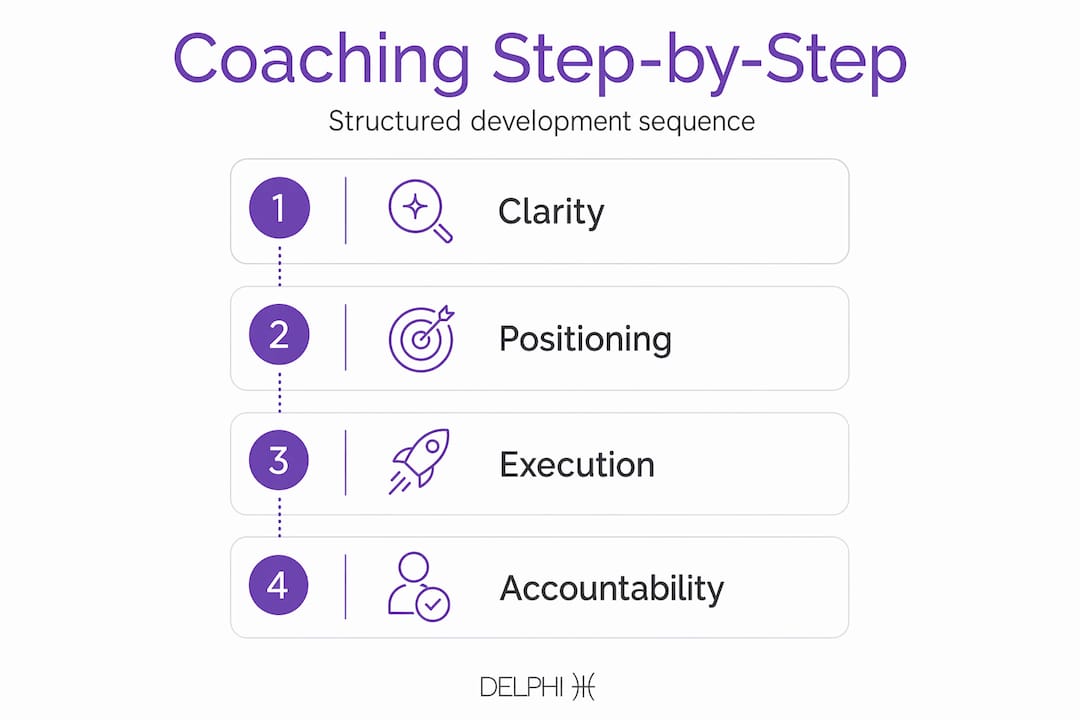
Career coaching frames the job search as an iterative system of clarity, positioning, execution, and review. That framing matters because it turns what often feels like a chaotic, demoralising experience into something you can actually manage and improve.
Here is how a typical coaching engagement unfolds:
- Clarity on your target role. Before anything else, you and your coach work out precisely what you are aiming for. Vague goals produce vague results. This stage involves assessing your skills, values, experience, and the realistic market for your ambitions.
- Materials improvement. Once the target is clear, your CV, LinkedIn profile, and cover letter approach are reviewed and rebuilt around that target. This is not cosmetic polishing. It is strategic repositioning.
- Application and interview strategy. Your coach helps you decide how many applications to send, which channels to prioritise, and how to prepare for interviews in a way that reflects your specific narrative rather than generic answers.
- Ongoing review and adjustment. This is the stage most people miss when they go it alone. A coach diagnoses where bottlenecks lie in your search. Getting interviews but no offers? The problem is interview performance, not the number of applications. Getting no interviews? The CV or targeting needs work. Each session feeds data back into the system.
Pro Tip: Keep a simple log of every application, response rate, and interview outcome. Sharing this with your coach at each session turns anecdote into evidence and makes adjustments far more precise.
The external accountability that a coach provides is not a soft benefit. It is often the single biggest reason people make faster progress with a coach than without one. Knowing you have a session in two weeks and need something to report on changes your behaviour between sessions.
Benefits of career coaching for young professionals
If you are early in your career or considering a significant change, the benefits of career coaching are particularly concrete. The challenges you face are not generic. They tend to cluster around a few specific problems: not knowing which direction to pursue, struggling to articulate your value on paper, underperforming in interviews despite being well-qualified, and losing momentum over a long search.
Here is how coaching addresses each of those directly:
- Focused role targeting. Rather than applying broadly and hoping, you identify a specific set of roles that match your background and goals. This alone dramatically improves response rates because your materials can be tailored rather than generic.
- Stronger CVs and profiles. Coaches push you to quantify your achievements. "Managed a team" becomes "Managed a team of six, reducing project delivery time by 20%." That shift is the difference between a CV that gets read and one that gets skipped.
- Interview preparation that goes beyond rehearsal. Good interview coaching is not just practising answers. It is developing a coherent professional narrative, understanding what interviewers are actually assessing, and learning to handle unexpected questions without losing composure.
- Salary negotiation support. Practical negotiation guidance helps you avoid leaving money on the table. Coaches provide framing techniques and timing advice that most candidates never consider.
- Sustained motivation. A long job search is psychologically hard. Coaching provides structure and progress markers that make the process feel manageable rather than endless.
Pro Tip: Before your first coaching session, write down the three specific outcomes you want from the engagement. Coaches are most effective when you come with a clear agenda rather than a general sense of wanting things to improve.
If you are feeling stuck in your career and unsure where to start, that clarity work is often the most valuable thing a coach can provide early on.

Misconceptions about career coaching to avoid
The biggest misconception is that career coaching is a shortcut. It is not. Coaching builds a repeatable process with external accountability rather than handing you a magic formula. You still have to do the work. What changes is the quality and direction of that work.
A few other misconceptions worth addressing directly:
- "I need a coach before I can start." You do not. The core coaching system, clarity, positioning, execution, review, is something you can begin applying on your own. A coach accelerates and sharpens that process. It does not create it from nothing.
- "Any coach will do." This is genuinely risky. Beware of coaches who offer a single session with no follow-up, no accountability mechanism, and no iterative review. A one-off conversation is not coaching. It is advice, and generic advice is plentiful online for free.
- "Coaching is therapy." Coaching does not explore your childhood or process grief. If deeper emotional work is needed, a therapist is the right person. Coaching assumes you are functioning well and focuses on moving forward.
- "A coach will tell me what to do." The best coaches do the opposite. They help you think more clearly so you can make better decisions independently. The goal is your autonomy, not your dependence on them.
The personalisation of coaching is what separates it from reading a careers book. Generic advice cannot account for your specific industry, seniority level, gaps in your history, or the particular way you come across in interviews. Tailored feedback can.
How to choose and work with a career coach
Choosing the right coach is not complicated, but it does require asking the right questions. Here is a comparison of what to look for versus what to be cautious about:
| What to look for | What to be cautious about |
|---|---|
| Structured multi-session programme | Single session with no follow-up |
| Accountability between sessions | No mechanism to track progress |
| Expertise relevant to your career stage | Generalist with no sector knowledge |
| Clear process: clarity, materials, execution, review | Vague promises about "transformation" |
| Honest feedback on your materials and performance | Only positive reinforcement |
Structured coaching packages that include email or chat support between sessions provide the feedback loop that makes real progress possible. A weekly or fortnightly session rhythm tends to work well for most people in active job searches.
When you start working with a coach, treat it as a partnership. You drive the agenda. The coach facilitates clarity, challenges your assumptions, and holds you accountable. If you are passive and wait to be told what to do, you will get less than half the value. For mid-level professionals in particular, the coaching relationship works best when you bring specific problems to each session rather than vague updates.
Questions worth asking a prospective coach before committing include: How do you structure your sessions? What happens between sessions? How do you measure progress? What does success look like at the end of our engagement?
My honest take on career coaching
I have seen career coaching work brilliantly and I have seen it waste people's time and money. The difference almost always comes down to one thing: structure.
In my experience, the coaches who produce the best results are the ones who treat the job search as a system to be diagnosed and improved, not a confidence problem to be solved with encouragement. The structured questioning process that good coaching uses leaves you with a clearer rationale for every decision you make, not just a checklist to follow.
What I find most underrated is the accountability piece. People dramatically underestimate how much their behaviour changes when someone else is watching their progress. It is not about pressure. It is about creating a feedback loop that does not exist when you are searching alone.
That said, I want to be honest about the limits. Coaching will not remove ambiguity from your career. It will not make a difficult job market easier. And it absolutely will not work if you are not willing to act on what you learn between sessions. The people who get the most from coaching are the ones who show up prepared, challenge themselves honestly, and treat each session as an investment rather than a service.
If you are considering a career change after redundancy or simply feeling directionless, coaching can fast-track the clarity work significantly. But it has to be the right coach, the right structure, and the right mindset from your side too.
— Bex
Ready to move forward with real support?
If this article has clarified what career coaching involves, the next step is finding a programme that fits your specific situation rather than a generic one-size approach.
Wearedelphi offers structured coaching programmes built around the exact stages described here: clarity, positioning, execution, and review. Whether you are building career momentum from scratch, working on professional confidence, or preparing for a high-stakes interview, there is a programme tailored to where you are right now. With over 3,500 sessions completed and a track record of helping clients gain genuine clarity, Wearedelphi brings the personalised structure that generic advice simply cannot offer. Explore the career coaching programmes and find the right starting point for your next move.
FAQ
What does a career coach do in a typical session?
A career coach helps you clarify goals, review your materials, prepare for interviews, or diagnose what is blocking your progress. Sessions are structured around your specific agenda and stage in the job search process.
How can a career coach help with a career change?
A career coach helps you identify transferable skills, reposition your CV for a new field, and develop a narrative that makes your change feel logical to employers rather than risky.
What is the difference between a career coach and a mentor?
A mentor shares their own career experience as informal guidance, while a career coach uses a structured process focused entirely on your goals and outcomes, regardless of their own career background.
What should I expect from career coaching sessions?
Expect structured, iterative sessions that build on each other, with accountability between meetings. Progress is measured against specific outcomes like application response rates, interview performance, and offer quality.
What questions should I ask a career coach before hiring them?
Ask about their session structure, how they track progress, what support they offer between sessions, and how they have helped clients at a similar career stage to yours.